art nou·veau
also Art Nou·veau (är′ no͞o-vō′, ärt′)n.
A style of decoration and architecture of the late 19th and early 20th centuries, characterized particularly by the depiction of leaves and flowers in flowing, sinuous lines.
[French : art, art + nouveau, new.]
American Heritage® Dictionary of the English Language, Fifth Edition. Copyright © 2016 by Houghton Mifflin Harcourt Publishing Company. Published by Houghton Mifflin Harcourt Publishing Company. All rights reserved.
Art Nouveau
(ɑː nuːˈvəʊ; French ar nuvo)n
(Art Movements)
a. a style of art and architecture of the 1890s, characterized by swelling sinuous outlines and stylized natural forms, such as flowers and leaves
b. (as modifier): an Art-Nouveau mirror.
[French, literally: new art]
Collins English Dictionary – Complete and Unabridged, 12th Edition 2014 © HarperCollins Publishers 1991, 1994, 1998, 2000, 2003, 2006, 2007, 2009, 2011, 2014
art nou•veau
(ˌɑrt nuˈvoʊ, ˌɑr)n.
(often caps.)
a style of fine and applied art current in the late 19th and early 20th centuries, characterized chiefly by curvilinear motifs.
[1900–05; < French: literally, new art]
Random House Kernerman Webster's College Dictionary, © 2010 K Dictionaries Ltd. Copyright 2005, 1997, 1991 by Random House, Inc. All rights reserved.
Art Nouveau
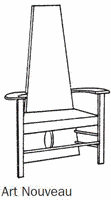

1. (c. 1890–1915) A development of the Arts and Crafts movement, with two main strands: one of fluid symmetry and flowing linear rhythms, one of geometrical austerity.
2. A dominant style of decoration and of avant-garde design in Europe from the 1880s to World War I. Called “Le Modern Style” in France, “Jugendstil” in Germany, and “stile Liberty” in Italy. Art Nouveau creatively adapted sinuous natural forms in an attempt to avoid architectural and design styles based on archeological recreations of the past. Also influenced by Japanese art.
Dictionary of Unfamiliar Words by Diagram Group Copyright © 2008 by Diagram Visual Information Limited
ThesaurusAntonymsRelated WordsSynonymsLegend:
| Noun | 1. | 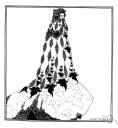 art nouveau - a French school of art and architecture popular in the 1890s; characterized by stylized natural forms and sinuous outlines of such objects as leaves and vines and flowers art nouveau - a French school of art and architecture popular in the 1890s; characterized by stylized natural forms and sinuous outlines of such objects as leaves and vines and flowersschool - a body of creative artists or writers or thinkers linked by a similar style or by similar teachers; "the Venetian school of painting" art movement, artistic movement - a group of artists who agree on general principles |
Based on WordNet 3.0, Farlex clipart collection. © 2003-2012 Princeton University, Farlex Inc.
Translations
Art Nouveau
art nouveau [ˌɑːrtnuːˈvəʊ]Collins English/French Electronic Resource. © HarperCollins Publishers 2005
Art Nouveau
Collins German Dictionary – Complete and Unabridged 7th Edition 2005. © William Collins Sons & Co. Ltd. 1980 © HarperCollins Publishers 1991, 1997, 1999, 2004, 2005, 2007