cangue
(kăng)n.
A flat wooden framework that is locked around a person's neck and borne on the shoulders, formerly used in China to punish petty criminals.
[French, from Portuguese canga, yoke, cangue, perhaps of Celtic origin; akin to Welsh cam, crooked.]
American Heritage® Dictionary of the English Language, Fifth Edition. Copyright © 2016 by Houghton Mifflin Harcourt Publishing Company. Published by Houghton Mifflin Harcourt Publishing Company. All rights reserved.
cangue
(kæŋ) orcang
n
(Historical Terms) (formerly in China) a large wooden collar worn by petty criminals as a punishment
[C18: from French, from Portuguese canga yoke]
Collins English Dictionary – Complete and Unabridged, 12th Edition 2014 © HarperCollins Publishers 1991, 1994, 1998, 2000, 2003, 2006, 2007, 2009, 2011, 2014
ThesaurusAntonymsRelated WordsSynonymsLegend:
| Noun | 1. | 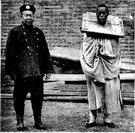 cangue - an instrument of punishment formerly used in China for petty criminals; consists of a heavy wooden collar enclosing the neck and arms cangue - an instrument of punishment formerly used in China for petty criminals; consists of a heavy wooden collar enclosing the neck and armsinstrument of punishment - an instrument designed and used to punish a condemned person |
Based on WordNet 3.0, Farlex clipart collection. © 2003-2012 Princeton University, Farlex Inc.