cy·clone
(sī′klōn′)n.
1. Meteorology
a. An atmospheric system characterized by the rapid inward circulation of air masses about a low-pressure center, usually accompanied by stormy, often destructive weather. Cyclones circulate counterclockwise in the Northern Hemisphere and clockwise in the Southern Hemisphere.
b. A violent tropical storm, especially one originating in the southwestern Pacific Ocean or Indian Ocean.
2. A violent rotating windstorm, especially a tornado.
3. Any of various devices using centrifugal force to separate materials.
[From Greek kuklōn, present participle of kukloun, to rotate, from kuklos, circle; see kwel- in Indo-European roots.]
cy·clon′ic (-klŏn′ĭk), cy·clon′i·cal adj.
American Heritage® Dictionary of the English Language, Fifth Edition. Copyright © 2016 by Houghton Mifflin Harcourt Publishing Company. Published by Houghton Mifflin Harcourt Publishing Company. All rights reserved.
cyclone
(ˈsaɪkləʊn)n
1. (Physical Geography) another name for depression6
2. (Physical Geography) a violent tropical storm; hurricane
[C19: from Greek kuklōn a turning around, from kukloun to revolve, from kuklos wheel]
cyclonic, cyˈclonical, ˈcyclonal adj
cyˈclonically adv
Cyclone
(ˈsaɪkləʊn)adj
(Agriculture) trademark Austral and NZ (of fencing) made of interlaced wire and metal
Collins English Dictionary – Complete and Unabridged, 12th Edition 2014 © HarperCollins Publishers 1991, 1994, 1998, 2000, 2003, 2006, 2007, 2009, 2011, 2014
cy•clone
(ˈsaɪ kloʊn)n.
1. a large-scale atmospheric wind-and-pressure system characterized by low pressure at its center and by circular wind motion, counterclockwise in the Northern Hemisphere, clockwise in the Southern Hemisphere.
2. (not in technical use) a tornado.
3. a device for removing small or powdered solids from air, water, or other gases or liquids by centrifugal force.
cy•clon′ic (-ˈklɒn ɪk) adj.
Random House Kernerman Webster's College Dictionary, © 2010 K Dictionaries Ltd. Copyright 2005, 1997, 1991 by Random House, Inc. All rights reserved.
cy·clone
(sī′klōn′)1. A system of winds that spiral in toward a region of low atmospheric pressure, circling counterclockwise in the Northern Hemisphere and clockwise in the Southern Hemisphere. Compare anticyclone.
2. A violent rotating windstorm, such as a hurricane or tornado.
Did You Know? Technically, a cyclone is nothing more than a region of low pressure around which air flows. In the Northern Hemisphere, the air moves counterclockwise around the low-pressure center, while in the Southern Hemisphere, the air travels clockwise. Meteorologists also refer to tropical cyclones, which develop over warm water and can be huge, severe storms. Strong tropical cyclones are better known as hurricanes or typhoons, depending on where in the world they occur. Hurricanes occur in the Atlantic Ocean and Gulf of Mexico, while typhoons occur in the Pacific Ocean. Such storms can be extremely devastating: two cyclones hit a coastal section of India within a few days of each other in 1999, killing an estimated 10,000 people. Because the word cyclone broadly defines a kind of air flow, cyclones are not confined to our planet. In 1999, the Hubble Space Telescope photographed a huge cyclone on Mars.
The American Heritage® Student Science Dictionary, Second Edition. Copyright © 2014 by Houghton Mifflin Harcourt Publishing Company. Published by Houghton Mifflin Harcourt Publishing Company. All rights reserved.
cyclone
an atmospheric disturbance characterized by powerful winds spinning in the shape of a vertical cylinder or horizontal disk, accompanied by low pressure at the center. — cyclonic, adj.
See also: Wind-Ologies & -Isms. Copyright 2008 The Gale Group, Inc. All rights reserved.
cyclone
A low-pressure tropical storm with high speed rotating winds.
Dictionary of Unfamiliar Words by Diagram Group Copyright © 2008 by Diagram Visual Information Limited
ThesaurusAntonymsRelated WordsSynonymsLegend:
| Noun | 1. | 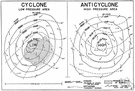 cyclone - (meteorology) rapid inward circulation of air masses about a low pressure center; circling counterclockwise in the northern hemisphere and clockwise in the southern cyclone - (meteorology) rapid inward circulation of air masses about a low pressure center; circling counterclockwise in the northern hemisphere and clockwise in the southernmeteorology - the earth science dealing with phenomena of the atmosphere (especially weather) atmospheric state, atmosphere - the weather or climate at some place; "the atmosphere was thick with fog" low, depression - an air mass of lower pressure; often brings precipitation; "a low moved in over night bringing sleet and snow" anticyclone - (meteorology) winds spiraling outward from a high pressure center; circling clockwise in the northern hemisphere and counterclockwise in the southern |
| 2. | cyclone - a violent rotating windstorm hurricane - a severe tropical cyclone usually with heavy rains and winds moving a 73-136 knots (12 on the Beaufort scale) tornado, twister - a localized and violently destructive windstorm occurring over land characterized by a funnel-shaped cloud extending toward the ground typhoon - a tropical cyclone occurring in the western Pacific or Indian oceans windstorm - a storm consisting of violent winds |
Based on WordNet 3.0, Farlex clipart collection. © 2003-2012 Princeton University, Farlex Inc.
cyclone
noun typhoon, hurricane, tornado, whirlwind, tempest, twister (U.S. informal), storm The death toll from the cyclone has now risen to one-hundred-and-forty.
Collins Thesaurus of the English Language – Complete and Unabridged 2nd Edition. 2002 © HarperCollins Publishers 1995, 2002
Translations
إِعْصَارإعصار، عاصِفَه دوّاره
bouřecyklóncyklóna
cyklonhvirvelstormorkan
ZyklonCyclone
pyörremyrskysykloni
ciklona
ciklon
hvirfilbylur, fellibylur
サイクロン
사이클론
ciklonas
ciklons
cyklón
ciklon
cyklon
พายุหมุนไซโคลน
lốc
Collins Spanish Dictionary - Complete and Unabridged 8th Edition 2005 © William Collins Sons & Co. Ltd. 1971, 1988 © HarperCollins Publishers 1992, 1993, 1996, 1997, 2000, 2003, 2005
Collins English/French Electronic Resource. © HarperCollins Publishers 2005
cyclone
n → Zyklon m; cyclone cellar (US) tiefer Keller zum Schutz vor Zyklonen
Collins German Dictionary – Complete and Unabridged 7th Edition 2005. © William Collins Sons & Co. Ltd. 1980 © HarperCollins Publishers 1991, 1997, 1999, 2004, 2005, 2007
Collins Italian Dictionary 1st Edition © HarperCollins Publishers 1995
cyclone
(ˈsaikləun) noun a violent wind-storm. The cyclone ripped the roofs off houses and tore up trees.
Kernerman English Multilingual Dictionary © 2006-2013 K Dictionaries Ltd.
cyclone
→ إِعْصَار cyklón cyklon Zyklon κυκλώνας ciclón pyörremyrsky cyclone ciklona ciclone サイクロン 사이클론 cycloon syklon cyklon ciclone циклон cyklon พายุหมุนไซโคลน siklon lốc 旋风Multilingual Translator © HarperCollins Publishers 2009