

ge·ode
(jē′ōd′)n.
A hollow, usually spheroidal rock with crystals lining the inside wall.
[French géode, from Latin geōdēs, a precious stone, from Greek, earthlike : gē, earth + -ōdēs, adj. suff.; see collodion.]
American Heritage® Dictionary of the English Language, Fifth Edition. Copyright © 2016 by Houghton Mifflin Harcourt Publishing Company. Published by Houghton Mifflin Harcourt Publishing Company. All rights reserved.
geode
(ˈdʒiːəʊd)n
(Geological Science) a cavity, usually lined with crystals, within a rock mass or nodule
[C17: from Latin geōdēs a precious stone, from Greek: earthlike; see geo-, -ode1]
geodic adj
Collins English Dictionary – Complete and Unabridged, 12th Edition 2014 © HarperCollins Publishers 1991, 1994, 1998, 2000, 2003, 2006, 2007, 2009, 2011, 2014
ge•ode
(ˈdʒi oʊd)n.
1. a hollow concretionary or nodular stone often lined with crystals.
2. the hollow or cavity of this.
Random House Kernerman Webster's College Dictionary, © 2010 K Dictionaries Ltd. Copyright 2005, 1997, 1991 by Random House, Inc. All rights reserved.

ge·ode
(jē′ōd′) A small, hollow, usually rounded rock lined on the inside with inward-pointing crystals. Geodes form when mineral-rich water entering a cavity in a rock undergoes a sudden change in pressure or temperature, causing crystals to form from the solution and line the cavity's walls.
The American Heritage® Student Science Dictionary, Second Edition. Copyright © 2014 by Houghton Mifflin Harcourt Publishing Company. Published by Houghton Mifflin Harcourt Publishing Company. All rights reserved.
geode
A hollow nodule of rock lined inside with crystals.
Dictionary of Unfamiliar Words by Diagram Group Copyright © 2008 by Diagram Visual Information Limited
ThesaurusAntonymsRelated WordsSynonymsLegend:
| Noun | 1. | 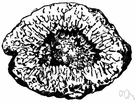 geode - (mineralogy) a hollow rock or nodule with the cavity usually lined with crystals geode - (mineralogy) a hollow rock or nodule with the cavity usually lined with crystalsmineralogy - the branch of geology that studies minerals: their structure and properties and the ways of distinguishing them nodule - (mineralogy) a small rounded lump of mineral substance (usually harder than the surrounding rock or sediment) |
Based on WordNet 3.0, Farlex clipart collection. © 2003-2012 Princeton University, Farlex Inc.