herd
drove or flock of animals; guard or protect: The shepherd will herd the sheep.
Not to be confused with:
heard – past tense of hear; listened to: I heard the news today.
Abused, Confused, & Misused Words by Mary Embree Copyright © 2007, 2013 by Mary Embree
herd
(hûrd)n.
1.
a. A group of cattle or other large herbivorous mammals of a single kind kept together for a specific purpose.
b. A number of wild animals of one species, especially large herbivorous mammals, that remain together as a group: a herd of elephants.
2.
a. A large number of people; a crowd: a herd of stranded passengers.
b. The multitude of common people regarded as a mass: "It is the luxurious and dissipated who set the fashions which the herd so diligently follow" (Henry David Thoreau).
v. herd·ed, herd·ing, herds
v.intr.
To come together in a herd: The sheep herded for warmth.
v.tr.
1. To gather, keep, or drive (animals) in a herd.
2. To tend (sheep or cattle).
3. To gather and place into a group or mass: herded the children into the auditorium.
[Middle English, from Old English heord.]
herd′er n.
American Heritage® Dictionary of the English Language, Fifth Edition. Copyright © 2016 by Houghton Mifflin Harcourt Publishing Company. Published by Houghton Mifflin Harcourt Publishing Company. All rights reserved.
herd
(hɜːd)n
1. (Zoology) a large group of mammals living and feeding together, esp a group of cattle, sheep, etc
2. often derogatory a large group of people
3. derogatory the large mass of ordinary people
vb
to collect or be collected into or as if into a herd
[Old English heord; related to Old Norse hjörth, Gothic hairda, Old High German herta, Greek kórthus troop]
herd
(hɜːd)n
(Agriculture)
a. archaic or dialect a man or boy who tends livestock; herdsman
b. (in combination): goatherd; swineherd.
vb (tr)
1. to drive forwards in a large group
2. (Agriculture) to look after (livestock)
[Old English hirde; related to Old Norse hirthir, Gothic hairdeis, Old High German hirti, Old Saxon hirdi, herdi; see herd1]
Collins English Dictionary – Complete and Unabridged, 12th Edition 2014 © HarperCollins Publishers 1991, 1994, 1998, 2000, 2003, 2006, 2007, 2009, 2011, 2014
herd1
(hɜrd)n.
1. a number of animals feeding, traveling, or kept together; drove; flock: a herd of zebras; a herd of sheep; a herd of cattle.
2. a large group of people; crowd; mob: a herd of autograph seekers.
3. a large group of things.
4. the herd, the common people; masses: to follow the herd.
v.i. 5. to unite or move in a herd; assemble or associate as a herd.
v.t. 6. to gather into or as if into a herd.
Idioms: ride herd on, to maintain control or discipline over.
[before 1000; Middle English; Old English heord, c. Old High German herta, Old Norse hjǫrth, Gothic hairda]
usage: See collective noun.
herd2
(hɜrd)v.t.
1. to tend, drive, or lead (cattle, sheep, etc.).
2. to conduct or drive (a group of people) to a destination.
[before 900; Middle English herd(e),hirde, Old English hierde, c. Old High German hirti, Old Norse hirthir, Gothic hairdeis; derivative of herd1]
Random House Kernerman Webster's College Dictionary, © 2010 K Dictionaries Ltd. Copyright 2005, 1997, 1991 by Random House, Inc. All rights reserved.
herd
- cutting horse - One trained to cut cattle out of a herd.
- pointer, point man - A pointer or point man was first a cowboy riding at the front of a herd of cattle.
- egregious - First meant "remarkably good" and "standing out or apart from the flock or herd; eminent"; its later derogatory sense is probably an ironical use.
- herd - As a verb, it first meant "keep safe, shelter."
Farlex Trivia Dictionary. © 2012 Farlex, Inc. All rights reserved.
Herd
a number of animals assembled together, chiefly large animals; a crowd of common people. See also flock, rabble.Examples: herd of antelopes; of asses; of attributes; of bison; of boars, 1735; of buffalo; of camels; of caribou, 1577; of cattle; of chamois, 1860; of cranes, 1470; of curlew; of deer, 1470; of elephants, 1875; of fallow beasts, 1576; of giraffes; of goats, 1700; of harlots, 1486; of harts, 1486; of coaches, 1618; of ibex; of mankind, 1665; of moose; of oxen; of parasites, 1818; of ponies; of porpoises, 1675; of seals, 1897; of swans, 1470; of swine, 1526; of sycophants; of whales, 1839; of wolves, 1697; of wrens, 1470.
Dictionary of Collective Nouns and Group Terms. Copyright 2008 The Gale Group, Inc. All rights reserved.
herd
Past participle: herded
Gerund: herding
| Imperative |
|---|
| herd |
| herd |
Collins English Verb Tables © HarperCollins Publishers 2011
ThesaurusAntonymsRelated WordsSynonymsLegend:
| Noun | 1. | 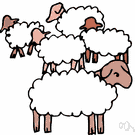 herd - a group of cattle or sheep or other domestic mammals all of the same kind that are herded by humans herd - a group of cattle or sheep or other domestic mammals all of the same kind that are herded by humansBos taurus, cattle, cows, kine, oxen - domesticated bovine animals as a group regardless of sex or age; "so many head of cattle"; "wait till the cows come home"; "seven thin and ill-favored kine"- Bible; "a team of oxen" sheep - woolly usually horned ruminant mammal related to the goat animal group - a group of animals remuda - the herd of horses from which those to be used the next day are chosen |
| 2. | herd - a group of wild mammals of one species that remain together: antelope or elephants or seals or whales or zebra animal group - a group of animals gam - a herd of whales | |
| 3. | herd - a crowd especially of ordinary or undistinguished persons or things; "his brilliance raised him above the ruck"; "the children resembled a fairy herd" | |
| Verb | 1. | herd - cause to herd, drive, or crowd together; "We herded the children into a spare classroom" move, displace - cause to move or shift into a new position or place, both in a concrete and in an abstract sense; "Move those boxes into the corner, please"; "I'm moving my money to another bank"; "The director moved more responsibilities onto his new assistant" overcrowd - cause to crowd together too much; "The students overcrowded the cafeteria" |
| 2. | herd - move together, like a herd crowd together, crowd - to gather together in large numbers; "men in straw boaters and waxed mustaches crowded the verandah" | |
| 3. | herd - keep, move, or drive animals; "Who will be herding the cattle when the cowboy dies?" keep - raise; "She keeps a few chickens in the yard"; "he keeps bees" wrangle - herd and care for; "wrangle horses" |
Based on WordNet 3.0, Farlex clipart collection. © 2003-2012 Princeton University, Farlex Inc.
herd
noun
1. flock, crowd, collection, mass, drove, crush, mob, swarm, horde, multitude, throng, assemblage, press large herds of elephant and buffalo
2. (Often disparaging) mob, the masses, rabble, populace, the hoi polloi, the plebs, riffraff They are individuals; they will not follow the herd.
verb
Collins Thesaurus of the English Language – Complete and Unabridged 2nd Edition. 2002 © HarperCollins Publishers 1995, 2002
herd
verbThe American Heritage® Roget's Thesaurus. Copyright © 2013, 2014 by Houghton Mifflin Harcourt Publishing Company. Published by Houghton Mifflin Harcourt Publishing Company. All rights reserved.
Translations
قَطيعيَجْمَع في قَطيع
stádonahnatshoufovat se
flokgennehjordhobhyrde
laumaliittyäpaimenpaimentaarahvas
csordagulyanyájösszeterelpásztor
hjörîreka saman, safna saman
bandos instinktaskaimenėpiemuosugintisuvaryti
barsganāmpulksganītsadzītsadzīt barā
čredakrdelo
stado
bir araya toplamaksürü
herd
[hɜːd]A. N [of cattle] → rebaño m, manada f; [of goats] → rebaño m; [of elephants] → manada f; [of pigs] → piara f; [of people] → multitud f, tropel m
the common herd → el vulgo, las masas
the common herd → el vulgo, las masas
herd together
Collins Spanish Dictionary - Complete and Unabridged 8th Edition 2005 © William Collins Sons & Co. Ltd. 1971, 1988 © HarperCollins Publishers 1992, 1993, 1996, 1997, 2000, 2003, 2005
herd
[ˈhɜːrd] vt
[+ people]
We were herded onto a bus → On nous fit monter dans un bus.
to be herded into a place → être parqué(e) dans un endroit
We were herded onto a bus → On nous fit monter dans un bus.
to be herded into a place → être parqué(e) dans un endroit
herd together
vi [people] → se serrer les uns contre les autres
Collins English/French Electronic Resource. © HarperCollins Publishers 2005
herd
Collins German Dictionary – Complete and Unabridged 7th Edition 2005. © William Collins Sons & Co. Ltd. 1980 © HarperCollins Publishers 1991, 1997, 1999, 2004, 2005, 2007
herd
[hɜːd]1. n (of cattle, horses) → mandria; (of wild animals, swine) → branco; (of people) (pej) the (common) herd → il gregge
herd together
1. vt + adv → radunare
2. vi + adv → stringersi uno vicino all'altro
Collins Italian Dictionary 1st Edition © HarperCollins Publishers 1995
herd
(həːd) noun a group of animals of one kind that stay, or are kept, together. a herd of cattle; a herd of elephant(s).
verb to gather together, or be brought together, in a group. The dogs herded the sheep together; The tourists were herded into a tiny room.
-herd a person who looks after a herd of certain kinds of animals. a goat-herd.
ˈherdsman (ˈhəːdz-) noun a person who looks after a herd of animals.
the herd instinct the tendency to behave, think etc like everyone else.
Kernerman English Multilingual Dictionary © 2006-2013 K Dictionaries Ltd.