bloat
(blōt)v. bloat·ed, bloat·ing, bloats
v.tr.
1. To cause to swell up or inflate, as with liquid or gas.
2. To cure (fish) by soaking in brine and half-drying in smoke.
v.intr.
To become swollen or inflated: "Government had bloated out of control" (Lance Morrow).
n.
1. A swelling of the rumen or intestinal tract of cattle and domestic animals that is caused by excessive gas formation following fermentation of ingested watery legumes or green forage.
2. An excess or surfeit, as of employees, expenses, or procedures: corporate bloat.
[From Middle English blout, soft, puffed, from Old Norse blautr, soft, soaked; see bhleu- in Indo-European roots.]
American Heritage® Dictionary of the English Language, Fifth Edition. Copyright © 2016 by Houghton Mifflin Harcourt Publishing Company. Published by Houghton Mifflin Harcourt Publishing Company. All rights reserved.
bloat
(bləʊt)vb
1. to swell or cause to swell, as with a liquid, air, or wind
2. to become or cause to be puffed up, as with conceit
3. (Cookery) (tr) to cure (fish, esp herring) by half-drying in smoke
n
(Veterinary Science) vet science an abnormal distention of the abdomen in cattle, sheep, etc, caused by accumulation of gas in the stomach
[C17: probably related to Old Norse blautr soaked, Old English blāt pale]
Collins English Dictionary – Complete and Unabridged, 12th Edition 2014 © HarperCollins Publishers 1991, 1994, 1998, 2000, 2003, 2006, 2007, 2009, 2011, 2014
bloat
(bloʊt)v.t.
1. to expand or distend, as with air or water; puff up.
v.i. 2. to become swollen.
n. 3. a gassy distension of the abdomen or other part of the digestive system.
4. a sheep, cow, or the like affected by bloat.
[1250–1300; earlier bloat (adj.) soft, puffy, Middle English blout < Old Norse blautr wet, soft]
Random House Kernerman Webster's College Dictionary, © 2010 K Dictionaries Ltd. Copyright 2005, 1997, 1991 by Random House, Inc. All rights reserved.
Bloat
of hippopotami—Lipton, 1970.Dictionary of Collective Nouns and Group Terms. Copyright 2008 The Gale Group, Inc. All rights reserved.
bloat
Past participle: bloated
Gerund: bloating
| Imperative |
|---|
| bloat |
| bloat |
Collins English Verb Tables © HarperCollins Publishers 2011
ThesaurusAntonymsRelated WordsSynonymsLegend:
| Noun | 1. | bloat - swelling of the rumen or intestinal tract of domestic animals caused by excessive gas |
| Verb | 1. | 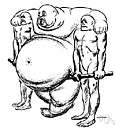 bloat - become bloated or swollen or puff up; "The dead man's stomach was bloated" bloat - become bloated or swollen or puff up; "The dead man's stomach was bloated" |
| 2. |  bloat - make bloated or swollen; "Hunger bloated the child's belly" bloat - make bloated or swollen; "Hunger bloated the child's belly"distend - cause to expand as it by internal pressure; "The gas distended the animal's body" swell - cause to become swollen; "The water swells the wood" |
Based on WordNet 3.0, Farlex clipart collection. © 2003-2012 Princeton University, Farlex Inc.
Translations
bloat
, bloatingn. distención abdominal, aventación;
vt. entumecerse, hincharse.
English-Spanish Medical Dictionary © Farlex 2012