grav·i·ty
(grăv′ĭ-tē)n.
1. Physics
a. The natural attraction between physical bodies, especially when one of the bodies is a celestial body, such as the earth.
b. See gravitation.
2. Grave consequence; seriousness or importance: They are still quite unaware of the gravity of their problems.
3. Solemnity or dignity of manner.
[French gravité, heaviness, from Old French, from Latin gravitās, from gravis, heavy; see gwerə- in Indo-European roots.]
American Heritage® Dictionary of the English Language, Fifth Edition. Copyright © 2016 by Houghton Mifflin Harcourt Publishing Company. Published by Houghton Mifflin Harcourt Publishing Company. All rights reserved.
gravity
(ˈɡrævɪtɪ)n, pl -ties
1. (General Physics) the force of attraction that moves or tends to move bodies towards the centre of a celestial body, such as the earth or moon
2. (General Physics) the property of being heavy or having weight. See also specific gravity, centre of gravity
3. (General Physics) another name for gravitation
4. seriousness or importance, esp as a consequence of an action or opinion
5. manner or conduct that is solemn or dignified
6. (Classical Music) lowness in pitch
7. (General Physics) (modifier) of or relating to gravity or gravitation or their effects: gravity wave; gravity feed.
[C16: from Latin gravitās weight, from gravis heavy]
Collins English Dictionary – Complete and Unabridged, 12th Edition 2014 © HarperCollins Publishers 1991, 1994, 1998, 2000, 2003, 2006, 2007, 2009, 2011, 2014
grav•i•ty
(ˈgræv ɪ ti)n., pl. -ties.
1. the force of attraction by which terrestrial bodies tend to fall toward the center of the earth.
2. heaviness or weight.
3. gravitation in general.
5. serious or critical nature: to ignore the gravity of one's illness.
6. serious or dignified behavior.
7. lowness in pitch, as of sounds.
Random House Kernerman Webster's College Dictionary, © 2010 K Dictionaries Ltd. Copyright 2005, 1997, 1991 by Random House, Inc. All rights reserved.
grav·i·ty
(grăv′ĭ-tē)1. The attraction that objects have for each other merely because they have mass and occupy space. Gravity is the weakest of the four basic forces in nature, being weaker than the strong nuclear force, the electromagnetic force, and the weak nuclear force. See more at acceleration, relativity.
2. This force as it operates in and around the Earth and other massive objects (such as the planets).
Did You Know? Isaac Newton discovered gravity, which he saw as the mutual attraction that two masses have for each other. Newton developed an equation that showed that any two objects in the universe, no matter how far apart or how small, exert an instantaneous gravitational effect on each other. These effects diminish, however, as the distance between the objects gets larger and as the masses of the objects get smaller, so that for many distant objects or objects with barely any mass, the effects of gravity are very small. Newton seemed to have the last word on gravity, until Albert Einstein came along. He noted that gravity's effects could not be instantaneous, since they would have to travel at infinite velocities, violating his theory of relativity, which states that nothing can travel faster than light. He also showed that gravity and acceleration are related. Imagine, he said, that you are an astronaut standing in a stationary rocket on Earth: because of Earth's gravity your feet are pressed against the rocket's floor with a force equal to your weight. Now imagine that you are in the same rocket, in outer space, in an area that has no gravitational pull. Even though you are weightless, if the rocket is accelerating and its floor is pushing against your feet, you feel as if you are being acted upon by a gravitational field. Unless you look out the window you have no idea whether the rocket is at rest on Earth or accelerating through space.
The American Heritage® Student Science Dictionary, Second Edition. Copyright © 2014 by Houghton Mifflin Harcourt Publishing Company. Published by Houghton Mifflin Harcourt Publishing Company. All rights reserved.
gravity
- Comes from Latin gravitas, from gravis, "heavy, important"—and it can apply to situations and problems as well as to people.See also related terms for problems.
Farlex Trivia Dictionary. © 2012 Farlex, Inc. All rights reserved.
Gravity
See also physics.
Medicine. the absence of the power to recognize weight through the senses; the absence of barognosis.
Medicine. the conscious perception of weight, especially through cutaneous and muscular nerves.
Archaic. a branch of physics that studied weight and its relationship to gravity.
an abnormal fear of gravity.
the movement of an organism in response to the force of gravity.
Botany. the response of a plant to the force of gravity. — geotropic, adj.
the theories of the 18th-century Yorkshireman John Hutchinson, which included a rejection of Newton’s theory of gravitation. See also bible; theology. — Hutchinsonian, adj.
a hypothetical force, opposed to gravity, once believed to be a property inherent in certain bodies or materials.
the production of motion in a body, apparently without the use of material force, a power long claimed by mediums and magicians. Also called teleportation. — telekinetic, adj.
the science or theory of tides.
-Ologies & -Isms. Copyright 2008 The Gale Group, Inc. All rights reserved.
gravity
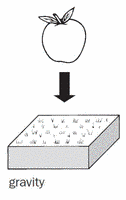

Intensity of gravitation measured at the surface of a star, planet or other heavenly body.
Dictionary of Unfamiliar Words by Diagram Group Copyright © 2008 by Diagram Visual Information Limited
ThesaurusAntonymsRelated WordsSynonymsLegend:
| Noun | 1. | 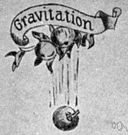 gravity - (physics) the force of attraction between all masses in the universe; especially the attraction of the earth's mass for bodies near its surface; "the more remote the body the less the gravity"; "the gravitation between two bodies is proportional to the product of their masses and inversely proportional to the square of the distance between them"; "gravitation cannot be held responsible for people falling in love"--Albert Einstein gravity - (physics) the force of attraction between all masses in the universe; especially the attraction of the earth's mass for bodies near its surface; "the more remote the body the less the gravity"; "the gravitation between two bodies is proportional to the product of their masses and inversely proportional to the square of the distance between them"; "gravitation cannot be held responsible for people falling in love"--Albert Einsteinnatural philosophy, physics - the science of matter and energy and their interactions; "his favorite subject was physics" attraction, attractive force - the force by which one object attracts another solar gravity - the gravity of the sun; "solar gravity creates extreme pressures and temperatures" |
| 2. | gravity - a manner that is serious and solemn serious-mindedness, earnestness, seriousness, sincerity - the trait of being serious; "a lack of solemnity is not necessarily a lack of seriousness"- Robert Rice stodginess, stuffiness - dull and pompous gravity | |
| 3. | gravity - a solemn and dignified feeling feeling - the experiencing of affective and emotional states; "she had a feeling of euphoria"; "he had terrible feelings of guilt"; "I disliked him and the feeling was mutual" levity - feeling an inappropriate lack of seriousness |
Based on WordNet 3.0, Farlex clipart collection. © 2003-2012 Princeton University, Farlex Inc.
gravity
noun
1. seriousness, importance, consequence, significance, urgency, severity, acuteness, moment, weightiness, momentousness, perilousness, hazardousness You don't seem to appreciate the gravity of this situation.
seriousness insignificance, triviality, unimportance, inconsequentiality
seriousness insignificance, triviality, unimportance, inconsequentiality
2. solemnity, gloom, seriousness, gravitas, thoughtfulness, grimness There was an appealing gravity to everything she said.
solemnity joy, happiness, gaiety, frivolity, merriment, levity, flippancy, thoughtlessness
solemnity joy, happiness, gaiety, frivolity, merriment, levity, flippancy, thoughtlessness
Related words
fear barophobia
fear barophobia
Collins Thesaurus of the English Language – Complete and Unabridged 2nd Edition. 2002 © HarperCollins Publishers 1995, 2002
gravity
noun1. The condition of being grave and of involving serious consequences:
2. High seriousness of manner or bearing:
The American Heritage® Roget's Thesaurus. Copyright © 2013, 2014 by Houghton Mifflin Harcourt Publishing Company. Published by Houghton Mifflin Harcourt Publishing Company. All rights reserved.
Translations
جاذِبِيَّهقُوة الجاذبيَّه
gravitacepřitažlivostvážnostzávažnost
alvortyngdetyngdekraft
gravitaatiopainovoima
gravitáció
gravitategravitation
gaya tarik bumigravitasi
òyngdarafl
引力重力
pievilkšanas spēks
tiaž
težnost
gravity
[ˈgrævɪtɪ]A. N
2. (= seriousness) [of situation, event] → gravedad f
this is a situation of the utmost gravity → ésta es una situación de la mayor gravedad
this is a situation of the utmost gravity → ésta es una situación de la mayor gravedad
3. (= solemnity) [of tone, manner] → gravedad f
B. CPD gravity feed N → alimentación f por gravedad
Collins Spanish Dictionary - Complete and Unabridged 8th Edition 2005 © William Collins Sons & Co. Ltd. 1971, 1988 © HarperCollins Publishers 1992, 1993, 1996, 1997, 2000, 2003, 2005
gravity
[ˈgrævɪti] nCollins English/French Electronic Resource. © HarperCollins Publishers 2005
gravity
n
(Phys) → Schwere f, → Schwerkraft f; the law(s) of gravity → das Gravitationsgesetz; centre (Brit) or center (US) of gravity → Schwerpunkt m; force of gravity → Schwerkraft f; gravity feed → Fall- or Schwerkraftspeisung f
(= seriousness, of person, expression, situation, matter, threat) → Ernst m; (of mistake, illness, crime) → Schwere f; (of danger, problem, difficulty) → Größe f; (of consequences) → schwerwiegende Art; the gravity of the news → die schlimmen Nachrichten
Collins German Dictionary – Complete and Unabridged 7th Edition 2005. © William Collins Sons & Co. Ltd. 1980 © HarperCollins Publishers 1991, 1997, 1999, 2004, 2005, 2007
Collins Italian Dictionary 1st Edition © HarperCollins Publishers 1995
gravity2
(ˈgrӕvəti) noun the force which attracts things towards the Earth and causes them to fall to the ground.
Kernerman English Multilingual Dictionary © 2006-2013 K Dictionaries Ltd.
grav·i·ty
n. fuerza de gravedad;
specific ___ → ___ específica.
English-Spanish Medical Dictionary © Farlex 2012