tu·ni·cate
(to͞o′nĭ-kĭt, -kāt′, tyo͞o′-)n.
Any of various chordate marine animals of the subphylum Urochordata (or Tunicata), having a cylindrical or globular body enclosed in a tough outer covering and a notochord in the larval stage, and including the sea squirts and salps.
adj.
1. Of or relating to the tunicates.
2. Anatomy Having a tunic.
3. Botany Having a tunic, as the bulb of an onion.
[Latin tunicātus, past participle of tunicāre, to clothe with a tunic, from tunica, tunic; see tunic.]
American Heritage® Dictionary of the English Language, Fifth Edition. Copyright © 2016 by Houghton Mifflin Harcourt Publishing Company. Published by Houghton Mifflin Harcourt Publishing Company. All rights reserved.
tunicate
(ˈtjuːnɪkɪt; -ˌkeɪt)n
(Animals) any minute primitive marine chordate animal of the subphylum Tunicata (or Urochordata, Urochorda). The adults have a saclike unsegmented body enclosed in a cellulose-like outer covering (tunic) and only the larval forms have a notochord: includes the sea squirts. See also ascidian
adj
1. (Animals) of, relating to, or belonging to the subphylum Tunicata
2. (Botany) (esp of a bulb) having or consisting of concentric layers of tissue
[C18: from Latin tunicātus clad in a tunic]
Collins English Dictionary – Complete and Unabridged, 12th Edition 2014 © HarperCollins Publishers 1991, 1994, 1998, 2000, 2003, 2006, 2007, 2009, 2011, 2014
tu•ni•cate
(ˈtu nɪ kɪt, -ˌkeɪt, ˈtyu-)n.
1. any marine chordate of the subphylum Tunicata (or Urochordata), having a saclike body enclosed in a thick membrane or tunic: includes ascidians and salps.
adj. 2. (esp. of the Tunicata) having a tunic or covering.
3. of or pertaining to the tunicates.
4. Bot. having or consisting of a series of concentric layers, as a bulb.
Also, tu′ni•cat`ed.Random House Kernerman Webster's College Dictionary, © 2010 K Dictionaries Ltd. Copyright 2005, 1997, 1991 by Random House, Inc. All rights reserved.
tu·ni·cate
(to͞o′nĭ-kĭt) Any of various primitive marine chordate animals having a rounded or cylindrical body that is enclosed in a tough outer covering. Tunicates start out life as free-swimming tadpole-like animals with a notochord (a primitive backbone), but many, such as the sea squirts, lose the notochord and most of their nervous system as adults and become fixed to rocks or other objects.
The American Heritage® Student Science Dictionary, Second Edition. Copyright © 2014 by Houghton Mifflin Harcourt Publishing Company. Published by Houghton Mifflin Harcourt Publishing Company. All rights reserved.
ThesaurusAntonymsRelated WordsSynonymsLegend:
| Noun | 1. | 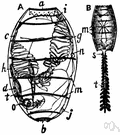 tunicate - primitive marine animal having a saclike unsegmented body and a urochord that is conspicuous in the larva tunicate - primitive marine animal having a saclike unsegmented body and a urochord that is conspicuous in the larvachordate - any animal of the phylum Chordata having a notochord or spinal column subphylum Tunicata, subphylum Urochorda, subphylum Urochordata, Tunicata, Urochorda, Urochordata - tunicates ascidian - minute sedentary marine invertebrate having a saclike body with siphons through which water enters and leaves doliolum - free-swimming oceanic tunicate with a barrel-shaped transparent body larvacean - any member of the class Larvacea appendicularia - free-swimming tadpole-shaped pelagic tunicate resembling larvae of other tunicates |
Based on WordNet 3.0, Farlex clipart collection. © 2003-2012 Princeton University, Farlex Inc.
Translations
tunicier