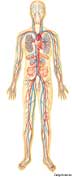

Arteries (red) carry blood rich in oxygen from the heart to tissues of the body. Veins (blue) carry blood low in oxygen back to the heart.
circulatory system
n.
1. The system of structures in vertebrates consisting of the heart, blood vessels, and lymphatics, by which blood and lymph are circulated throughout the body.
2. A similar system by which a fluid, such as hemolymph, is distributed in other animals.
American Heritage® Dictionary of the English Language, Fifth Edition. Copyright © 2016 by Houghton Mifflin Harcourt Publishing Company. Published by Houghton Mifflin Harcourt Publishing Company. All rights reserved.
circulatory system
n
(Anatomy) anatomy zoology the system concerned with the transport of blood and lymph, consisting of the heart, blood vessels, lymph vessels, etc
Collins English Dictionary – Complete and Unabridged, 12th Edition 2014 © HarperCollins Publishers 1991, 1994, 1998, 2000, 2003, 2006, 2007, 2009, 2011, 2014
cir′culatory sys`tem
n.
the system of organs and tissues, including the heart, blood, blood vessels, lymph, lymphatic vessels and glands, involved in circulating blood and lymph through the body.
Random House Kernerman Webster's College Dictionary, © 2010 K Dictionaries Ltd. Copyright 2005, 1997, 1991 by Random House, Inc. All rights reserved.
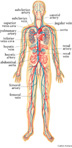
In the diagram above, the blood vessels of the circulatory system are colored according to whether they carry blood that is high in oxygen (red) or low in oxygen (blue). Most arteries, which carry blood away from the heart, are colored red; most veins, which carry blood back toward the heart, are colored blue.
cir·cu·la·to·ry system
(sûr′kyə-lə-tôr′ē) The system that circulates blood through the body, consisting of the heart and blood vessels. In all vertebrates and certain invertebrates, the circulatory system is completely contained within a network of vessels. In vertebrates, the lymphatic system is also considered part of the circulatory system.
The American Heritage® Student Science Dictionary, Second Edition. Copyright © 2014 by Houghton Mifflin Harcourt Publishing Company. Published by Houghton Mifflin Harcourt Publishing Company. All rights reserved.
ThesaurusAntonymsRelated WordsSynonymsLegend:
| Noun | 1. |  circulatory system - the organs and tissues involved in circulating blood and lymph through the body circulatory system - the organs and tissues involved in circulating blood and lymph through the bodybody, organic structure, physical structure - the entire structure of an organism (an animal, plant, or human being); "he felt as if his whole body were on fire" liver - large and complicated reddish-brown glandular organ located in the upper right portion of the abdominal cavity; secretes bile and functions in metabolism of protein and carbohydrate and fat; synthesizes substances involved in the clotting of the blood; synthesizes vitamin A; detoxifies poisonous substances and breaks down worn-out erythrocytes ticker, heart, pump - the hollow muscular organ located behind the sternum and between the lungs; its rhythmic contractions move the blood through the body; "he stood still, his heart thumping wildly" blood stream, bloodstream - the blood flowing through the circulatory system lymph - a thin coagulable fluid (similar to plasma but) containing white blood cells (lymphocytes) and chyle; is conveyed to the blood stream by lymphatic vessels blood vessel - a vessel in which blood circulates vein, vena, venous blood vessel - a blood vessel that carries blood from the capillaries toward the heart; "all veins except the pulmonary vein carry unaerated blood" venous blood system, venation - (zoology) the system of venous blood vessels in an animal vascular system - the vessels and tissue that carry or circulate fluids such as blood or lymph or sap through the body of an animal or plant fetal circulation, foetal circulation - the system of blood vessels and structures through which blood moves in a fetus |
Based on WordNet 3.0, Farlex clipart collection. © 2003-2012 Princeton University, Farlex Inc.
Translations
oběhová soustava
sistema circulatorio
verenkiertojärjestelmä
循環器
bloedvatenstelsel
circulatory system
n (Med) → apparato circolatorioCollins Italian Dictionary 1st Edition © HarperCollins Publishers 1995