sleep
(slēp)sleep
(sliːp)sleep
(slip)v. slept, sleep•ing,
n. v.i.
sleep
(slēp)Sleep
2. the resulting state.
1. a method of treating certain mental disorders by inducing sleep through barbiturates.
2. a type of psychotherapy involving the use of hypnotic drugs. Also narcoanalysis. — narcotherapist, n.
2. the words spoken. — somniloquist, n. — somniloquous, adj.
Sleep
- Asleep and dreaming, like bees in cells of honey —Thomas McGuane
The simile completed McGuane’s novel, The Sporting Club,
- As near to sleep as a runner waiting for the starter’s pistol —J. B. Priestley
- As sound asleep as a coon in a hollow log —Borden Deal
- Awoke … like some diver emerging from the depths of ocean —Francis King
- (Paul lay in his berth) between wakefulness and sleep, like a partially anesthetized patient —John Cheever
- (Mr. Samuel Pickwick) burst like another sun from his slumbers —Charles Dickens
- Came out of a deep sleep slowly, like a diver pausing at each successive level —Norman Garbo
- Come from sleep as if returning from a far country —Mary Hedin
The simile which begins the story, Blue Transfer, continues with, “A stranger to myself, a stranger to my life.”
- Doze and dream like a lazy snake —George Garrett
- Drowsy as an audience for a heavy speech after an even heavier dinner —Anon
- Emerges from slumber like some deep-sea creature hurled floundering and gasping up into the light of day by a depth-charge —Francis King
- Fell into a sleep as blank as paving-stone —Patrick White
- Felt himself falling asleep like gliding down a long slide, like slipping from a float into deep water —Oakley Hall
- Heavy with sleep, like faltering, lisping tongues —Boris Pasternak
- I shall sleep like a top —Sir William Davenant
This simile has outlived the play from which it is taken, The Rivals, as a colloquial expression. A somewhat different version, “Slept like any top” appeared in the German children’s story, Struwelpeter, by Heinrich Hoffman.
- I want sleep to water me like begonias —Diane Wakoski
- Kept falling in and out of it [sleep] like out of a boat or a tipping hammock —Rose Tremain
- Lies asleep as softly as a girl dreaming of lovers she cannot keep —F. D. Reeve
Reeves, a poet, is describing a river.
- Lying awake like a worried parent —Robert Silverberg
- Nodding, like a tramp on a park bench —Robert Traver
- Not sleeping but dozing awake like a snake on stone —Malcolm Cowley
- Sleep as smooth as banana skins —Diane Wakoski
See Also: SMOOTHNESS
- Sleep came over my head like a gunny sack —Ross Macdonald
- Sleep covered him like a breaker —Harris Downey
- Sleep fell on her like a blow —Hortense Calisher
- Sleeping like a lake —Theodore Roethke
- Sleeping like a stone in an empty alcove of the cathedral —Clive Cussler
- Sleep like a dark flood suspended in its course —Percy Bysshe Shelley
- Sleep like a kitten, arrive fresh as a daisy —Slogan, Chesapeake & Ohio Railroad
- Slept like a cocked pistol —Émile Zola
- Slept a great deal, as if years of fatigue had overtaken him —Peter Matthiessen
- Slept almost smiling, as if she had a secret —William Mcllvanney
- (He usually) slept like a corpse —Ring Lardner
- (While the Weary Blues echoed through his head, he) slept like a rock or a man that’s dead —Langston Hughes
- Slept like he’d gone twelve rounds with a pro —Geoffrey Wolff
See Also: WEARINESS
- Slumber fell on their tired eyelids like the light rain of spring upon the fresh-turned earth —W. Somerset Maugham
- Sunk into sleep like a stone dropped in a well —John Yount
- Wake abruptly, with an alarm clock which breaks up their sleep like the blow of an ax —Milan Kundera
Sleep
drive one’s pigs to market To snore loudly, to log ZZZs. The allusion is probably to the snorting noises of swine being herded to market. This expression is apparently an elaboration of the phrase to drive pigs ‘to snore,’ dating from the early 19th century.
forty winks A brief nap; a short period of relaxation. This expression, clearly derived from the closed-eye position assumed during sleep, nevertheless implies that the resting person will not fall sound asleep. It is reputed that the first literary use of the phrase appeared in the November 16, 1872, issue of Punch, in which the writer surmised that the reading of the Thirty-nine Articles of faith by the communicants of the Anglican Church was indeed a somniferous ordeal:
If a … man, after reading steadily through the Thirty-nine Articles, were to take forty winks. …
hit the deck See EXCLAMATIONS.
hit the sack To go to bed; to retire for the night; also, hit the hay. During World War II, sack was substituted for “bed” among American soldiers as an allusion to the sleeping bags or blankets they used as beds. J. J. Fahey used the expression in Pacific War Diary (1943):
I hit the sack at 8 P.M. I slept under the stars on a steel ammunition box two feet wide.
Variations of the phrase include sack time, sack drill, and sack duty, all military slang for time spent asleep; sack artist, a soldier who is adept at obtaining extra sleep; and sack out, a common term for sleeping until fully refreshed.
in the arms of Morpheus In deep sleep; overcome with the desire to sleep. In Greek mythology Morpheus was the god of dreams. The narcotic morphine, which dulls pain and induces sleep, gets its name from the same deity.
in the Land of Nod Asleep; in dreamland. After Cain killed Abel, he was banished to wander in the Land of Nod (Genesis 4:16). Land of Nod did not mean sleep until Swift made a pun on the Biblical phrase in his Complete Collection of Genteel and Ingenious Conversation (1730). Today Nod retains the meaning of sleep.
In the nighttime, when human beings … are absent in the Land of Nod. (Chambers, Journal of Popular Literature, 1900)
saw wood To sleep soundly; to snore. This expression came into popular use in the early 20th century primarily as a result of the commonly employed cartoonist’s technique of representing sleep with a drawing of a saw cutting through wood, alluding, of course, to the sound of snoring.
shut-eye Sleep. A 20th-century American colloquialism.
That shut-eye done me good. (Boyd Cable, Old Contempt, 1919)
sleep like a top To sleep soundly, like a log; to be dead to the world. The rationale for the seemingly anomalous reference to a top is explained by Anne Baker in Glossary of Northamptonshire Words and Phrases (1854):
A top sleeps when it moves with such velocity, and spins so smoothly, that its motion is imperceptible.
Likewise, when a Yo-Yo spins swiftly at the end of its string, it is said to “sleep,” without apparent motion. By extension, then, though a person in a deep, peaceful sleep may seem totally motionless, his internal systems are actually working at a high level of efficiency.
Juan slept like a top, or like the dead. (George Gordon, Lord Byron, Don Juan, 1819)
sleep
– asleepSleep can be a noun or a verb. The past tense and -ed participle of the verb is slept.
Sleep is the natural state of rest in which you are unconscious with your eyes closed.
To sleep means to be in this state of rest.
If someone is in this state, you can use the progressive form and say they are sleeping, but it is more common to say that they are asleep. Don't say, for example, 'He sleeps'.
To say how long someone was in this state, or to talk about where or how someone usually sleeps, use sleep rather than asleep.
Be Careful!
Asleep is only used after a verb. Don't use it in front of a noun. Don't, for example, say 'an asleep child'. Instead use sleeping.
Don't say that someone is 'very asleep' or 'completely asleep'. Instead say that they are sound asleep or fast asleep.
When someone changes from being awake to being asleep, you say that they go to sleep.
When someone goes to sleep suddenly or unexpectedly, you say that they fall asleep.
When someone goes to sleep with difficulty, for example because of noise or worries, you say that they get to sleep.
When someone goes to sleep again after being woken up, you say that they go back to sleep.
If something causes you to sleep, you say that it sends you to sleep.
sleep
Past participle: slept
Gerund: sleeping
| Imperative |
|---|
| sleep |
| sleep |
| Noun | 1. | 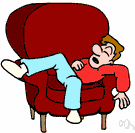 sleep - a natural and periodic state of rest during which consciousness of the world is suspended; "he didn't get enough sleep last night"; "calm as a child in dreamless slumber" sleep - a natural and periodic state of rest during which consciousness of the world is suspended; "he didn't get enough sleep last night"; "calm as a child in dreamless slumber"sleeping - the state of being asleep nonrapid eye movement, nonrapid eye movement sleep, NREM, NREM sleep, orthodox sleep - a recurring sleep state during which rapid eye movements do not occur and dreaming does not occur; accounts for about 75% of normal sleep time paradoxical sleep, rapid eye movement, rapid eye movement sleep, REM, REM sleep - a recurring sleep state during which dreaming occurs; a state of rapidly shifting eye movements during sleep shuteye - informal term for sleep physical condition, physiological condition, physiological state - the condition or state of the body or bodily functions |
| 2. | sleep - a torpid state resembling deep sleep physical condition, physiological condition, physiological state - the condition or state of the body or bodily functions | |
| 3. | 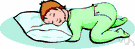 sleep - a period of time spent sleeping; "he felt better after a little sleep"; "there wasn't time for a nap" sleep - a period of time spent sleeping; "he felt better after a little sleep"; "there wasn't time for a nap"period, period of time, time period - an amount of time; "a time period of 30 years"; "hastened the period of time of his recovery"; "Picasso's blue period" beauty sleep - sleep before midnight kip - sleep; "roused him from his kip" | |
| 4. | sleep - euphemisms for death (based on an analogy between lying in a bed and in a tomb); "she was laid to rest beside her husband"; "they had to put their family pet to sleep" death - the absence of life or state of being dead; "he seemed more content in death than he had ever been in life" | |
| Verb | 1. | sleep - be asleep rest - be at rest practice bundling, bundle - sleep fully clothed in the same bed with one's betrothed sleep in, sleep late - sleep later than usual or customary; "On Sundays, I sleep in" hibernate, hole up - sleep during winter; "Bears must eat a lot of food before they hibernate in their caves" sleep in, sleep late - sleep later than usual or customary; "On Sundays, I sleep in" live in, sleep in - live in the house where one works; "our babysitter lives in, as it is too far to commute for her" sleep out, live out - work in a house where one does not live; "our cook lives out; he can easily commute from his home" wake - be awake, be alert, be there |
| 2. | sleep - be able to accommodate for sleeping; "This tent sleeps six people" accommodate, admit, hold - have room for; hold without crowding; "This hotel can accommodate 250 guests"; "The theater admits 300 people"; "The auditorium can't hold more than 500 people" |
sleep
"Oh Sleep! it is a gentle thing,"
"Beloved from pole to pole,"
"To Mary Queen the praise be given!"
"She sent the gentle sleep from Heaven,"
"That slid into my soul" [Samuel Taylor Coleridge The Ancient Mariner]
"Come, sleep, O sleep, the certain knot of peace,"
"The baiting place of wit, the balm of woe" [Philip Sidney Astrophil and Stella]
"to sleep: perchance to dream" [William Shakespeare Hamlet]
"sleep the twin of death" [Homer Iliad]
"The sleep of a labouring man is sweet" Bible: Ecclesiastes
"Care-charmer Sleep, son of the sable Night,"
"Brother to Death, in silent darkness born" [Samuel Daniel Delia]
"Care-charming Sleep, thou easer of all woes,"
"Brother to Death" [John Fletcher Wit Without Money]
"I sleep like a baby. I wake up every 10 minutes screaming" [Boris Jordan]
"One hour's sleep before midnight is worth two after"
sleep
nounsleep in
sleep with
sleep
[sliːp] (slept (vb: pt, pp))lack of sleep → falta f de sueño
I need some sleep → necesito dormir
to drop off to sleep → quedarse dormido
he fell into a deep sleep → se quedó profundamente dormido
I couldn't get to sleep → no podía dormirme or conciliar el sueño
to go to sleep [person] → dormirse, quedarse dormido; (= limb) → dormirse
to have a sleep → dormir
to have a good night's sleep → dormir bien (durante) toda la noche
to have a little sleep → dormir un rato, descabezar un sueño
I shan't lose any sleep over it → eso no me va a quitar el sueño
to put sb to sleep [+ patient] → dormir a algn
to put an animal to sleep (euph) (= kill) → sacrificar un animal
to send sb to sleep (= bore) → dormir a algn
to talk in one's sleep → hablar en sueños
to walk in one's sleep → pasearse dormido; (habitually) → ser sonámbulo
she walked downstairs in her sleep → estando dormida bajó la escalera
I didn't get a wink of sleep all night → no pegué ojo en toda la noche
to sleep the sleep of the just → dormir a pierna suelta
I couldn't sleep last night → anoche no pude dormir
to sleep deeply → dormir profundamente or a pierna suelta
to sleep heavily (habitually) → tener el sueño pesado; (on particular occasion) → dormir profundamente
to sleep lightly (habitually) → tener el sueño ligero
she was sleeping lightly → no estaba profundamente dormida
to sleep on sth (fig) → consultar algo con la almohada
to sleep out (= not at home) → dormir fuera de casa; (= in open air) → dormir al aire libre, pasar la noche al raso
to sleep soundly → dormir profundamente or a pierna suelta
he was sleeping soundly → estaba profundamente dormido
he slept through the alarm clock → no oyó el despertador
I slept through till the afternoon → dormí hasta la tarde
sleep tight! → ¡que duermas bien!, ¡que descanses!
to sleep with sb (euph) (= have sex) → acostarse con algn
to sleep like a log or top or baby → dormir como un tronco
see also rough B
she's sleeping off the effects of the drug → duerme hasta que desaparezcan los efectos de la droga
to sleep it off sleep off a hangover → dormir la mona, dormir la curda
sleep
[ˈsliːp]I need some sleep
BUT J'ai besoin de dormir.
to go to sleep → s'endormir
to get to sleep → s'endormir
I can't get to sleep → Je n'arrive pas à m'endormir., Je n'arrive pas à trouver le sommeil.
to have a good night's sleep → passer une bonne nuit
to lose sleep over sth
I didn't lose any sleep over it → Ça ne m'a pas empêché de dormir.
to put sb to sleep [+ patient] → endormir qn
to put an animal to sleep (= kill) → piquer un animal
I couldn't sleep last night → J'ai mal dormi la nuit dernière.
to sleep lightly → avoir le sommeil léger
to sleep with sb (= have sex) → coucher avec qn
to sleep together → coucher ensemble
We can sleep four → On peut loger quatre personnes., On peut coucher quatre personnes.
sleep
vb: pret, ptp <slept>sleep
:sleep
[sliːp] (slept (vb: pt, pp))deep or sound sleep → sonno profondo
to have a good night's sleep → farsi una bella dormita
to drop off or go to sleep → addormentarsi
to go to sleep (limb) → intorpidirsi
to put to sleep (patient) → anestetizzare (animal) (euph) (kill) → abbattere
to talk in one's sleep → parlare nel sonno
to walk in one's sleep → camminare nel sonno (as a habit) → essere sonnambulo/a
to send sb to sleep (bore) → far addormentare qn
I shan't lose any sleep over it (fig) → non starò a perderci il sonno
to sleep like a log or top → dormire della grossa or come un ghiro
he was sleeping soundly or deeply → era profondamente addormentato
to sleep lightly → avere il sonno leggero
let's sleep on it (fig) → la notte porta consiglio, dormiamoci sopra
sleep tight! → sogni d'oro!
I slept through the storm/alarm clock → non ho sentito il temporale/la sveglia
he slept at his mother's → ha dormito dalla mamma
to sleep with sb (euph) (have sex) → andare a letto con qn