stave
(stāv)n.
1.
a. A narrow strip of wood forming part of the sides of a barrel, tub, or similar structure.
b. One of the wooden planks in a stave wall.
2. A rung of a ladder or chair.
3. A staff or cudgel.
4. Music See staff1.
5. A set of verses; a stanza.
tr.v. staved or stove (stōv), stav·ing, staves
Phrasal Verb: To crush or smash inward, often by making a hole. Often used with in: "The jetliner had staved in the south side of the structure. The plane had ripped a hole 150 feet wide" (Bill Sammon).
stave off
To keep or hold off; repel: "For 12 years, we've sought to stave off this ultimate threat of disaster" (New York Times).
[Back-formation from staves, pl. of staff.]
American Heritage® Dictionary of the English Language, Fifth Edition. Copyright © 2016 by Houghton Mifflin Harcourt Publishing Company. Published by Houghton Mifflin Harcourt Publishing Company. All rights reserved.
stave
(steɪv)n
1. (Building) any one of a number of long strips of wood joined together to form a barrel, bucket, boat hull, etc
2. (Furniture) any of various bars, slats, or rods, usually of wood, such as a rung of a ladder or a crosspiece bracing the legs of a chair
3. any stick, staff, etc
4. (Poetry) a stanza or verse of a poem
5. (Music, other) music
a. Brit an individual group of five lines and four spaces used in staff notation
b. another word for staff19
vb, staves, staving, staved or stove
6. (often foll by in) to break or crush (the staves of a boat, barrel, etc) or (of the staves of a boat) to be broken or crushed
7. (usually foll by: in) to burst or force (a hole in something)
8. (Building) (tr) to provide (a ladder, chair, etc) with a stave or staves
9. (Medicine) (tr) Scot to sprain (a finger, toe, etc)
[C14: back formation from staves, plural of staff1]
Collins English Dictionary – Complete and Unabridged, 12th Edition 2014 © HarperCollins Publishers 1991, 1994, 1998, 2000, 2003, 2006, 2007, 2009, 2011, 2014
stave
(steɪv)n., v. staved stove, stav•ing. n.
1. one of the thin, narrow, shaped pieces of wood that form the sides of a cask, tub, or similar vessel.
2. a stick, rod, pole, or the like.
3. a rung of a ladder, chair, etc.
4.
v.t. a. a verse or stanza of a poem or song.
b. the alliterating sound in a line of verse, as the w-sound in wind in the willows.
6. to break in a stave or staves of (a cask or barrel) so as to release the wine, liquor, or other contents.
7. to break or crush (something) inward (often fol. by in).
8. to break (a hole) in, esp. in the hull of a boat.
9. to break to pieces; splinter; smash.
10. to furnish with a stave or staves.
11. to beat with a stave or staff.
v.i. 12. to become staved in, as a boat; break in or up.
13. to move along rapidly.
14. stave off,
a. to put, ward, or keep off, as by force or evasion.
b. to prevent in time; forestall: to stave off bankruptcy.
[1125–75; (n.) Middle English, back formation from staves; (v.) derivative of the n.]
Random House Kernerman Webster's College Dictionary, © 2010 K Dictionaries Ltd. Copyright 2005, 1997, 1991 by Random House, Inc. All rights reserved.
stave
Past participle: staved/stove
Gerund: staving
| Imperative |
|---|
| stave |
| stave |
Collins English Verb Tables © HarperCollins Publishers 2011
ThesaurusAntonymsRelated WordsSynonymsLegend:
| Noun | 1. | stave - (music) the system of five horizontal lines on which the musical notes are written musical notation - (music) notation used by musicians staff line - any of the 5 horizontal marks comprising a staff space - one of the areas between or below or above the lines of a musical staff; "the spaces are the notes F-A-C-E" music - an artistic form of auditory communication incorporating instrumental or vocal tones in a structured and continuous manner |
| 2. | stave - one of several thin slats of wood forming the sides of a barrel or bucket | |
| 3. | 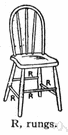 stave - a crosspiece between the legs of a chair stave - a crosspiece between the legs of a chaircrosspiece - a transverse brace folding chair - a chair that can be folded flat for storage feeding chair, highchair - a chair for feeding a very young child; has four long legs and a footrest and a detachable tray rocking chair, rocker - a chair mounted on rockers side chair, straight chair - a straight-backed chair without arms | |
| Verb | 1. | stave - furnish with staves; "stave a ladder" |
| 2. | stave - burst or force (a hole) into something burst, break open, split - come open suddenly and violently, as if from internal pressure; "The bubble burst" |
Based on WordNet 3.0, Farlex clipart collection. © 2003-2012 Princeton University, Farlex Inc.
stave
nounA fairly long straight piece of solid material used especially as a support in walking:
stave off
The American Heritage® Roget's Thesaurus. Copyright © 2013, 2014 by Houghton Mifflin Harcourt Publishing Company. Published by Houghton Mifflin Harcourt Publishing Company. All rights reserved.
Translations
مُدَرَّج موسيقي
notová osnova
fem nodelinier
nótnastrengur
penklinė
nošu līnija
notová osnova
stave
[steɪv] N2. (Mus) → pentagrama m
3. (Literat) → estrofa f
stave in VT + ADV (stove in (pt, pp)) → desfondar
Collins Spanish Dictionary - Complete and Unabridged 8th Edition 2005 © William Collins Sons & Co. Ltd. 1971, 1988 © HarperCollins Publishers 1992, 1993, 1996, 1997, 2000, 2003, 2005
stave
[ˈsteɪv]Collins English/French Electronic Resource. © HarperCollins Publishers 2005
stave
Collins German Dictionary – Complete and Unabridged 7th Edition 2005. © William Collins Sons & Co. Ltd. 1980 © HarperCollins Publishers 1991, 1997, 1999, 2004, 2005, 2007
stave
[steɪv] n (Mus) = staff 1cstave in vt + adv (stove in (pt, pp)) → sfondare
stave off vt + adv (staved off (pt, pp)) (crisis, threat, illness) → evitare; (attack) → respingere; (temporarily) → allontanare
Collins Italian Dictionary 1st Edition © HarperCollins Publishers 1995
stave
(steiv) noun in music, a staff.
Kernerman English Multilingual Dictionary © 2006-2013 K Dictionaries Ltd.