shield
(shēld)n.
1. A broad piece of armor made of rigid material and strapped to the arm or carried in the hand for protection against hurled or thrusted weapons.
2. A person or thing that provides protection.
3. A protective device or structure, as:
a. A steel sheet attached to an artillery piece to protect gunners from small-arms fire and shrapnel.
b. Physics A wall or housing of concrete or lead built around a nuclear reactor to prevent the escape of radiation.
c. Electronics A structure or arrangement of metal plates or mesh designed to protect a piece of electronic equipment from electrostatic or magnetic interference.
d. A pad worn, as at the armpits, to protect a garment from perspiration.
e. A sanitary napkin.
4. Zoology A protective plate or similar hard outer covering; a scute or scutellum.
5. Something that resembles a shield, as:
a. An escutcheon.
b. A decorative emblem that often serves to identify an organization or a government.
c. A police officer's badge.
6. Geology The ancient, stable, interior layer of continents composed of primarily Precambrian igneous or metamorphic rocks. Also called continental shield.
v. shield·ed, shield·ing, shields
v.tr.
1. To protect from being attacked, exposed to danger, or subjected to difficulty: "a policymaking elite whose families and purses are shielded from the sacrifices war entails" (Uwe E. Reinhardt). See Synonyms at defend.
2. To cover up; conceal: "Though many eyes were watching, none could pierce the halo of morning sunlight that surrounded and shielded the hawk" (Peter Dunne).
v.intr.
To act or serve as a shield or safeguard.
shield′er n.
American Heritage® Dictionary of the English Language, Fifth Edition. Copyright © 2016 by Houghton Mifflin Harcourt Publishing Company. Published by Houghton Mifflin Harcourt Publishing Company. All rights reserved.
shield
(ʃiːld)n
1. (Arms & Armour (excluding Firearms)) any protection used to intercept blows, missiles, etc, such as a tough piece of armour carried on the arm
2. any similar protective device
3. (Heraldry) heraldry Also called: scutcheon or escutcheon a pointed stylized shield used for displaying armorial bearings
4. anything that resembles a shield in shape, such as a prize in a sports competition
5. (Zoology) the protective outer covering of an animal, such as the shell of a turtle
6. (Nuclear Physics) physics a structure of concrete, lead, etc, placed around a nuclear reactor or other source of radiation in order to prevent the escape of radiation
7. (Geological Science) a broad stable plateau of ancient Precambrian rocks forming the rigid nucleus of a particular continent. See Baltic Shield, Canadian Shield
8. (Clothing & Fashion) short for dress shield
9. (Civil Engineering) civil engineering a hollow steel cylinder that protects men driving a circular tunnel through loose, soft, or water-bearing ground
10. (Cricket) Austral short for the Sheffield Shield
11. (Rugby) NZ short for the Ranfurly Shield
vb
(tr) to protect, hide, or conceal (something) from danger or harm
[Old English scield; related to Old Norse skjöldr, Gothic skildus, Old High German scilt shield, Old English sciell shell]
ˈshielder n
ˈshieldˌlike adj
Collins English Dictionary – Complete and Unabridged, 12th Edition 2014 © HarperCollins Publishers 1991, 1994, 1998, 2000, 2003, 2006, 2007, 2009, 2011, 2014
shield
(ʃild)n.
1. a device used as a defense against blows or hurled objects, esp. a broad piece of armor carried on the arm or in the hand.
2. a person or thing that guards or defends.
3. any of various devices or barriers for protection, as from injury.
4. an escutcheon typically having a broad top and pointed bottom and displaying armorial bearings.
5. something shaped like a shield.
6. a police officer's, detective's, or sheriff's badge.
7. a bulletproof screen attached to a gun to protect its crew, mechanism, etc.
8. a protective plate or the like on the body of an animal, as a scute, enlarged scale, etc.
9. a pad worn or attached inside the underarm of a garment to protect it against perspiration stains.
10. a vast area of ancient crustal rocks which, together with a platform, constitutes a craton.
11. a lead or concrete structure around a nuclear reactor serving as a barrier against escaping radiation.
v.t. 12. to protect with or as if with a shield.
13. to serve as a protection for.
14. to hide or conceal; protect by hiding.
15. Obs. to avert; forbid.
v.i. 16. to act or serve as a shield.
[before 900; Old English sceld, c. Old Frisian skeld, Old High German skilt, Old Norse skjǫldr, Gothic skildus]
shield′er, n.
shield′less, adj.
Random House Kernerman Webster's College Dictionary, © 2010 K Dictionaries Ltd. Copyright 2005, 1997, 1991 by Random House, Inc. All rights reserved.
shield
Past participle: shielded
Gerund: shielding
| Imperative |
|---|
| shield |
| shield |
Collins English Verb Tables © HarperCollins Publishers 2011
ThesaurusAntonymsRelated WordsSynonymsLegend:
| Noun | 1. |  shield - a protective covering or structure shield - a protective covering or structure nipple shield - a rubber or plastic shield to protect the nipples of nursing women scale, shell, plate - a metal sheathing of uniform thickness (such as the shield attached to an artillery piece to protect the gunners) protective cover, protective covering, protection - a covering that is intend to protect from damage or injury; "they had no protection from the fallout"; "wax provided protection for the floors" shielding - a shield of lead or concrete intended as a barrier to radiation emitted in nuclear decay shielding - shield consisting of an arrangement of metal mesh or plates designed to protect electronic equipment from ambient electromagnetic interference |
| 2. |  shield - armor carried on the arm to intercept blows shield - armor carried on the arm to intercept blowsscutcheon, escutcheon - a shield; especially one displaying a coat of arms | |
| 3. | 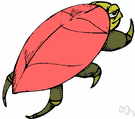 shield - hard outer covering or case of certain organisms such as arthropods and turtles shield - hard outer covering or case of certain organisms such as arthropods and turtlesturtle - any of various aquatic and land reptiles having a bony shell and flipper-like limbs for swimming arthropod - invertebrate having jointed limbs and a segmented body with an exoskeleton made of chitin cuticula - the outer body wall of an insect scute - large bony or horny plate as on an armadillo or turtle or the underside of a snake mollusc, mollusk, shellfish - invertebrate having a soft unsegmented body usually enclosed in a shell shell - the material that forms the hard outer covering of many animals | |
| Verb | 1. | shield - protect, hide, or conceal from danger or harm protect - shield from danger, injury, destruction, or damage; "Weatherbeater protects your roof from the rain" |
| 2. | shield - hold back a thought or feeling about; "She is harboring a grudge against him" |
Based on WordNet 3.0, Farlex clipart collection. © 2003-2012 Princeton University, Farlex Inc.
shield
noun
1. protection, cover, defence, screen, guard, ward (archaic), shelter, safeguard, aegis, rampart, bulwark innocents used as a human shield against attack
2. buckler, escutcheon (Heraldry), targe (archaic) a warrior with sword and shield
verb
Collins Thesaurus of the English Language – Complete and Unabridged 2nd Edition. 2002 © HarperCollins Publishers 1995, 2002
shield
nounThe act or a means of defending:
The American Heritage® Roget's Thesaurus. Copyright © 2013, 2014 by Houghton Mifflin Harcourt Publishing Company. Published by Houghton Mifflin Harcourt Publishing Company. All rights reserved.
Translations
štítchránitkrytodznakzakrývat
skjoldafskærmebeskyttepræmiepladeskærme for
kaitse
kilpisuojasuojata
štit
pajzsvédelem
skjöldurskÿlaskÿla, hlífa, verndaverîlaunaskjöldurvernda
保護する保護物盾
방패을 보호하다
scutum
apsaugaskydasženklelis
aizklātaizsargātaizsargsaizsegsaizsegt
pavăzăscut
krytštítzakrývať
ščitzaščititi
sköldskydda
โล่
cái khiên
shield
[ʃiːld]A. N
1. (armour, also Her) → escudo m (Tech) (on machine etc) → blindaje m, capa f protectora
2. (US) (= badge) [of policeman] → placa f
Collins Spanish Dictionary - Complete and Unabridged 8th Edition 2005 © William Collins Sons & Co. Ltd. 1971, 1988 © HarperCollins Publishers 1992, 1993, 1996, 1997, 2000, 2003, 2005
shield
[ˈʃiːld] n
[soldier, warrior] → bouclier m
(also riot shield) → bouclier m antiémeute
(= protection) → protection f, écran m
a shield against the sun → un écran contre le soleil
He used his left hand as a shield against the reflecting sunlight
BUT Il se servit de sa main gauche pour protéger ses yeux de la lumière du soleil. human shield
a shield against the sun → un écran contre le soleil
He used his left hand as a shield against the reflecting sunlight
BUT Il se servit de sa main gauche pour protéger ses yeux de la lumière du soleil. human shield
(= trophy) → trophée m
(US) (= police badge) insigne en forme de bouclier porté par les officiers de police américains
Collins English/French Electronic Resource. © HarperCollins Publishers 2005
shield
n (Mil, Her) → Schild m; (Zool also) → Panzer m; (= sporting trophy also) → Trophäe f; (on machine) → Schutzschirm or -schild m; (= eyeshield, radiation shield) → Schirm m; (fig) → Schutz m; riot shield → Schutzschild m; God is our shield → Gott ist unser Schild
Collins German Dictionary – Complete and Unabridged 7th Edition 2005. © William Collins Sons & Co. Ltd. 1980 © HarperCollins Publishers 1991, 1997, 1999, 2004, 2005, 2007
shield
[ʃiːld]Collins Italian Dictionary 1st Edition © HarperCollins Publishers 1995
shield
(ʃiːld) noun1. a broad piece of metal, wood etc carried as a protection against weapons.
2. something or someone that protects. A thick steel plate acted as a heat shield.
3. a trophy shaped like a shield won in a sporting competition etc. My son has won the archery shield.
verb (often with from).
1. to protect. The goggles shielded the motorcyclist's eyes from dust.
2. to prevent from being seen clearly. That group of trees shields the house from the road.
Kernerman English Multilingual Dictionary © 2006-2013 K Dictionaries Ltd.
shield
→ تُرْس štít skjold Schild ασπίδα escudo kilpi bouclier štit scudo 盾 방패 schild skjold tarcza escudo щит sköld โล่ kalkan cái khiên 盾Multilingual Translator © HarperCollins Publishers 2009
shield
n. escudo, cubierta.
English-Spanish Medical Dictionary © Farlex 2012