solar system
n.
1. often Solar System The sun together with the eight planets and all other celestial bodies that orbit the sun.
2. A system of planets or other bodies orbiting a star.
American Heritage® Dictionary of the English Language, Fifth Edition. Copyright © 2016 by Houghton Mifflin Harcourt Publishing Company. Published by Houghton Mifflin Harcourt Publishing Company. All rights reserved.
solar system
n
(Astronomy) the system containing the sun and the bodies held in its gravitational field, including the planets (Mercury, Venus, Earth, Mars, Jupiter, Saturn, Uranus, and Neptune), the dwarf planets (Eris, Pluto, and Ceres), the asteroids, and comets
Collins English Dictionary – Complete and Unabridged, 12th Edition 2014 © HarperCollins Publishers 1991, 1994, 1998, 2000, 2003, 2006, 2007, 2009, 2011, 2014
so′lar sys`tem
n.
the sun together with all the planets and other bodies that revolve around it.
[1695–1705]
Random House Kernerman Webster's College Dictionary, © 2010 K Dictionaries Ltd. Copyright 2005, 1997, 1991 by Random House, Inc. All rights reserved.


solar system
1. Often Solar System The sun together with the planets and all other bodies that orbit the sun, including moons, asteroids, and comets. See more at nebular hypothesis.
2. A system of planets or other bodies orbiting another star.
Did You Know? Usually, we think of the solar system as simply including the sun and the planets. We may even remember the moons that revolve around several planets. But actually, the solar system contains billions of other objects as well and extends far beyond the orbit of Neptune. Several hundred thousand asteroids have been discovered, and countless smaller asteroids, including the chunks of debris formed during the collision of larger bodies, are out there as well. These smaller particles may come near Earth—as many as a billion meteors, most the size of a speck of dust, cross through our planet's atmosphere each day. Astronomers have recorded more than 800 comets passing through the inner part of the solar system. Billions more, however, lie in the area surrounding the solar system, in the far reaches of the swarm of comets known as the Oort cloud or in the disk of debris known as the Kuiper belt. All of these objects travel around the sun at high speeds in paths called orbits. Some of these orbits, like those of the planets near the sun, are almost circular. Other orbits, like those of comets that make their way in among the planets, are stretched out into long ellipses.
The American Heritage® Student Science Dictionary, Second Edition. Copyright © 2014 by Houghton Mifflin Harcourt Publishing Company. Published by Houghton Mifflin Harcourt Publishing Company. All rights reserved.
solar system
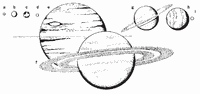
Our solar system consists of nine planets. The diameter of each planet, at its equator, is given here. a Mercury 3,031 mi (4,878 km) b Venus 7,521 mi (12,104 km) c Earth 7,926 mi (12,756 km) d Mars 4,222 mi (6,795 km) e Jupiter 88,732 mi (142,800 km) f Saturn 74,565 mi (120,000 km) g Uranus 31,566 mi (50,800 km) h Neptune 30,137 mi (48,500 km) i Pluto 3,725 mi (5,995 km)
Dictionary of Unfamiliar Words by Diagram Group Copyright © 2008 by Diagram Visual Information Limited
ThesaurusAntonymsRelated WordsSynonymsLegend:
| Noun | 1. |  solar system - the sun with the celestial bodies that revolve around it in its gravitational field solar system - the sun with the celestial bodies that revolve around it in its gravitational fieldsystem, scheme - a group of independent but interrelated elements comprising a unified whole; "a vast system of production and distribution and consumption keep the country going" heliosphere - the region inside the heliopause containing the sun and solar system earth, globe, world - the 3rd planet from the sun; the planet we live on; "the Earth moves around the sun"; "he sailed around the world" interplanetary medium - interplanetary space including forms of energy and gas and dust Jupiter - the largest planet and the 5th from the sun; has many satellites and is one of the brightest objects in the night sky Edgeworth-Kuiper belt, Kuiper belt - a disk-shaped region of minor planets outside the orbit of Neptune Mars, Red Planet - a small reddish planet that is the 4th from the sun and is periodically visible to the naked eye; minerals rich in iron cover its surface and are responsible for its characteristic color; "Mars has two satellites" Mercury - the smallest planet and the nearest to the sun minor planet, planetoid - any of numerous small celestial bodies that move around the sun Neptune - a giant planet with a ring of ice particles; the 8th planet from the sun is the most remote of the gas giants; "the existence of Neptune was predicted from perturbations in the orbit of Uranus and it was then identified in 1846" outer planet - (astronomy) a major planet whose orbit is outside the asteroid belt (Jupiter, Saturn, Uranus, Neptune, Pluto) major planet, planet - (astronomy) any of the nine large celestial bodies in the solar system that revolve around the sun and shine by reflected light; Mercury, Venus, Earth, Mars, Jupiter, Saturn, Uranus, Neptune, and Pluto in order of their proximity to the sun; viewed from the constellation Hercules, all the planets rotate around the sun in a counterclockwise direction Pluto - a small planet and the farthest known planet from the sun; it has the most elliptical orbit of all the planets; "Pluto was discovered by Clyde Tombaugh in 1930" Saturn - a giant planet that is surrounded by three planar concentric rings of ice particles; the 6th planet from the sun Sun - the star that is the source of light and heat for the planets in the solar system; "the sun contains 99.85% of the mass in the solar system"; "the Earth revolves around the Sun" Uranus - a giant planet with a ring of ice particles; the 7th planet from the sun has a blue-green color and many satellites; "Uranus was discovered by William Herschel in 1781" Venus - the second nearest planet to the sun; it is peculiar in that its rotation is slow and retrograde (in the opposite sense of the Earth and all other planets except Uranus); it is visible from Earth as an early `morning star' or an `evening star'; "before it was known that they were the same object the evening star was called Venus and the morning star was called Lucifer" |
Based on WordNet 3.0, Farlex clipart collection. © 2003-2012 Princeton University, Farlex Inc.
Translations
النِّظام الشَّمْسيمنظومة شمسيةنِظَامٌ شَمْسِيّ
sluneční soustava
solsystem
SonnensystemCeresEris
aurinkokunta
solarni sustav
naprendszer
sólkerfi
太陽系
태양계
Saulės sistema
slnečná sústava
solsystem
ระบบสุริยะจักรวาล
hệ mặt trời
solar
(ˈsəulə) adjective having to do with, powered by, or influenced by, the sun. the solar year; a solar heating system.
solar ˈpanel noun a piece of equipment, usually installed on a roof, that absorbs energy from the sun to heat water or turn it into electricity.
ˌsolar-ˈpowered adjectivesolar system
the Sun or any star and the planets which move round it.
Kernerman English Multilingual Dictionary © 2006-2013 K Dictionaries Ltd.
solar system
→ نِظَامٌ شَمْسِيّ sluneční soustava solsystem Sonnensystem ηλιακό σύστημα sistema solar aurinkokunta système solaire solarni sustav sistema solare 太陽系 태양계 zonnestelsel solsystem układ słoneczny sistema solar солнечная система solsystem ระบบสุริยะจักรวาล güneş sistemi hệ mặt trời 太阳系Multilingual Translator © HarperCollins Publishers 2009