mi·o·sis
also my·o·sis (mī-ō′sĭs)n. pl. mi·o·ses (-sēz) also my·o·ses
Constriction of the pupil of the eye, resulting from a normal response to an increase in light or caused by certain drugs or pathological conditions.
[Greek mūein, to close the eyes + -osis.]
American Heritage® Dictionary of the English Language, Fifth Edition. Copyright © 2016 by Houghton Mifflin Harcourt Publishing Company. Published by Houghton Mifflin Harcourt Publishing Company. All rights reserved.
miosis
(maɪˈəʊsɪs) ormyosis
n, pl -ses (-siːz)
1. (Pathology) excessive contraction of the pupil of the eye, as in response to drugs
2. (Biology) a variant spelling of meiosis1
[C20: from Greek muein to shut the eyes + -osis]
miotic, myotic adj, n
Collins English Dictionary – Complete and Unabridged, 12th Edition 2014 © HarperCollins Publishers 1991, 1994, 1998, 2000, 2003, 2006, 2007, 2009, 2011, 2014
mi•o•sis
or my•o•sis
(maɪˈoʊ sɪs)n.
excessive constriction of the pupil of the eye.
Compare mydriasis. [1810–20; variant of myosis < Greek mý(ein) to shut (the eyes) + -osis]
Random House Kernerman Webster's College Dictionary, © 2010 K Dictionaries Ltd. Copyright 2005, 1997, 1991 by Random House, Inc. All rights reserved.
miosis, myosis
abnormal constriction of the pupil of the eye, caused by drugs or illness. Cf. mydriasis. — miotic, myotic, adj.
See also: Eyes-Ologies & -Isms. Copyright 2008 The Gale Group, Inc. All rights reserved.
ThesaurusAntonymsRelated WordsSynonymsLegend:
| Noun | 1. | 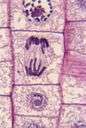 miosis - (genetics) cell division that produces reproductive cells in sexually reproducing organisms; the nucleus divides into four nuclei each containing half the chromosome number (leading to gametes in animals and spores in plants) miosis - (genetics) cell division that produces reproductive cells in sexually reproducing organisms; the nucleus divides into four nuclei each containing half the chromosome number (leading to gametes in animals and spores in plants)genetic science, genetics - the branch of biology that studies heredity and variation in organisms anaphase - the stage of meiosis or mitosis when chromosomes move toward opposite ends of the nuclear spindle cell division, cellular division - the process in reproduction and growth by which a cell divides to form daughter cells cytokinesis - organic process consisting of the division of the cytoplasm of a cell following karyokinesis bringing about the separation into two daughter cells karyokinesis - organic process consisting of the division of the nucleus of a cell during mitosis or meiosis metaphase - the second stage of meiosis nondisjunction - meiosis in which there is a failure of paired homologous chromosomes to separate; results in an abnormal number of chromosomes in the daughter cells prophase - the first stage of meiosis segregation - (genetics) the separation of paired alleles during meiosis so that members of each pair of alleles appear in different gametes telophase - the final stage of meiosis when the chromosomes move toward opposite ends of the nuclear spindle |
| 2. |  miosis - reflex contraction of the sphincter muscle of the iris in response to a bright light (or certain drugs) causing the pupil to become smaller miosis - reflex contraction of the sphincter muscle of the iris in response to a bright light (or certain drugs) causing the pupil to become smallerinborn reflex, innate reflex, instinctive reflex, physiological reaction, reflex, reflex action, reflex response, unconditioned reflex - an automatic instinctive unlearned reaction to a stimulus |
Based on WordNet 3.0, Farlex clipart collection. © 2003-2012 Princeton University, Farlex Inc.