eclipse
the obscuring of the light from one celestial body by the passage of another between it and the observer: lunar eclipse; solar eclipse; a sudden loss of importance in relation to a newly arrived person or thing: The status of the lead actress was eclipsed by a young ingénue in the film.
Abused, Confused, & Misused Words by Mary Embree Copyright © 2007, 2013 by Mary Embree


solar eclipse
e·clipse
(ĭ-klĭps′)n.
1.
a. The partial or complete obscuring, relative to a designated observer, of one celestial body by another.
b. The period of time during which such an obscuration occurs.
2. A temporary or permanent dimming or cutting off of light.
3.
a. A fall into obscurity or disuse; a decline: "A composer ... often goes into eclipse after his death and never regains popularity" (Time).
b. A disgraceful or humiliating end; a downfall: Revelations of wrongdoing helped bring about the eclipse of the governor's career.
tr.v. e·clipsed, e·clips·ing, e·clips·es
1.
a. To cause an eclipse of.
b. To obscure; darken.
2.
a. To obscure or diminish in importance, fame, or reputation.
b. To surpass; outshine: an outstanding performance that eclipsed the previous record.
[Middle English, from Old French, from Latin eclīpsis, from Greek ekleipsis, from ekleipein, to fail to appear, suffer an eclipse : ek-, out; see ecto- + leipein, to leave; see leikw- in Indo-European roots.]
American Heritage® Dictionary of the English Language, Fifth Edition. Copyright © 2016 by Houghton Mifflin Harcourt Publishing Company. Published by Houghton Mifflin Harcourt Publishing Company. All rights reserved.
eclipse
(ɪˈklɪps)n
1. (Astronomy) the total or partial obscuring of reflected light from a celestial body as a result of its passage through the shadow of another. A lunar eclipse occurs when the moon passes through the shadow of the earth. See also solar eclipse, total eclipse, partial eclipse, annular eclipse Compare occultation
2. (Astronomy) the period of time during which such a phenomenon occurs
3. any dimming or obstruction of light
4. a loss of importance, power, fame, etc, esp through overshadowing by another
vb (tr)
5. (Astronomy) to cause an eclipse of
6. to cast a shadow upon; darken; obscure
7. to overshadow or surpass in importance, power, etc
[C13: back formation from Old English eclypsis, from Latin eclīpsis, from Greek ekleipsis a forsaking, from ekleipein to abandon, from leipein to leave]
eˈclipser n
Collins English Dictionary – Complete and Unabridged, 12th Edition 2014 © HarperCollins Publishers 1991, 1994, 1998, 2000, 2003, 2006, 2007, 2009, 2011, 2014
e•clipse
(ɪˈklɪps)n., v. e•clipsed, e•clips•ing. n.
1.
a. the obscuring of the light of the moon by the intervention of the earth between it and the sun (lunar eclipse) or the obscuring of the light of the sun by the intervention of the moon between it and a point on the earth (solar eclipse).
b. a similar phenomenon with respect to any other planet, its moon, and the sun.
c. the partial or complete interception of the light of one component of a binary star by the other.
2. any obscuring of light.
3. a reduction or loss of splendor, status, or reputation.
v.t. 4. to cause to undergo eclipse: The moon eclipsed the sun.
5. to make less outstanding or important by comparison; surpass.
[1250–1300; < Old French eclipse < Latin eclīpsis < Greek ékleipsis, derivative of ekleípein to leave out, fail to appear]
e•clips′er, n.
Random House Kernerman Webster's College Dictionary, © 2010 K Dictionaries Ltd. Copyright 2005, 1997, 1991 by Random House, Inc. All rights reserved.

A solar eclipse occurs when the moon passes between the sun and the Earth. An observer within the umbra will witness a total solar eclipse, while someone within the penumbra will observe a partial solar eclipse.
e·clipse
(ĭ-klĭps′) The partial or total blocking of light from one celestial body as it passes behind or through the shadow of another celestial body. ♦ In a solar eclipse the moon comes between the sun and Earth. ♦ In a lunar eclipse the moon enters Earth's shadow.
Did You Know? Purely by chance, the sun is about 400 times wider than the moon but also 400 times farther from Earth. For this reason, they appear to be almost exactly the same size in the sky. Our unique vantage point makes for the spectacular phenomenon of a total solar eclipse, when the moon blocks out the sun. A total solar eclipse reveals the beautiful and delicate corona, wispy tendrils of charged gases that surround the sun but are invisible to the unaided eye in normal sunlight. The orbits of Earth around the sun and of the moon around Earth are not perfect circles. Therefore the sun and moon may vary slightly in how big they appear to us, and the length of total solar eclipses can also vary. The maximum duration of a solar eclipse, however, when Earth is farthest from the sun and the moon is nearest to Earth, is only seven and a half minutes. Since looking at the sun can cause blindness, it is safest to view any solar eclipse indirectly. A good method is to project the image through a pinhole in a piece of paper onto another piece of paper.
The American Heritage® Student Science Dictionary, Second Edition. Copyright © 2014 by Houghton Mifflin Harcourt Publishing Company. Published by Houghton Mifflin Harcourt Publishing Company. All rights reserved.
eclipse
Past participle: eclipsed
Gerund: eclipsing
| Imperative |
|---|
| eclipse |
| eclipse |
Collins English Verb Tables © HarperCollins Publishers 2011
ThesaurusAntonymsRelated WordsSynonymsLegend:
| Noun | 1. | 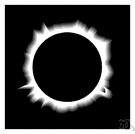 eclipse - one celestial body obscures another eclipse - one celestial body obscures anotherbreak, interruption - some abrupt occurrence that interrupts an ongoing activity; "the telephone is an annoying interruption"; "there was a break in the action when a player was hurt" solar eclipse - the moon interrupts light from the sun lunar eclipse - the earth interrupts light shining on the moon total eclipse - an eclipse as seen from a place where the eclipsed body is completely obscured partial eclipse - an eclipse in which the eclipsed body is only partially obscured |
| Verb | 1. | eclipse - be greater in significance than; "the tragedy overshadowed the couple's happiness" bulk large, brood, loom, hover - hang over, as of something threatening, dark, or menacing; "The terrible vision brooded over her all day long" |
| 2. | eclipse - cause an eclipse of (a celestial body) by intervention; "The Sun eclipses the moon today"; "Planets and stars often are occulted by other celestial bodies" overshadow - cast a shadow upon; "The tall tree overshadowed the house" |
Based on WordNet 3.0, Farlex clipart collection. © 2003-2012 Princeton University, Farlex Inc.
eclipse
noun
1. obscuring, covering, blocking, shading, dimming, extinction, darkening, blotting out, occultation a total eclipse of the sun
2. decline, fall, loss, failure, weakening, deterioration, degeneration, diminution the eclipse of the influence of the Republican party in West Germany
verb
Collins Thesaurus of the English Language – Complete and Unabridged 2nd Edition. 2002 © HarperCollins Publishers 1995, 2002
eclipse
verbThe American Heritage® Roget's Thesaurus. Copyright © 2013, 2014 by Houghton Mifflin Harcourt Publishing Company. Published by Houghton Mifflin Harcourt Publishing Company. All rights reserved.
Translations
كُسوف الشَّمْس، خُسوف القَمَريَتَفَوَّقيَكْسِفُ الشَّمْس أو القَمَر
zatmění
eklipseformørkeoverskyggesolformørkelse
jättää varjoonsapimennyspimentää
pomrčina
fogyatkozás
myrkva; skyggja ámyrkviskyggja á, bera afsólmyrkvi
eclipsis
užtemdytiužtemimas
aizēnotaptumšotaptumsums
byť v zatmenízatmenie
mrk
gölgelemektutulmatutulmak
Collins Spanish Dictionary - Complete and Unabridged 8th Edition 2005 © William Collins Sons & Co. Ltd. 1971, 1988 © HarperCollins Publishers 1992, 1993, 1996, 1997, 2000, 2003, 2005
Collins English/French Electronic Resource. © HarperCollins Publishers 2005
eclipse
n (Astron) → Eklipse f (spec), → Finsternis f; (fig) (of fame, theory) → Verblassen nt; (of person) → Niedergang m; eclipse of the sun/moon → Sonnen-/Mondfinsternis f; to be in eclipse (sun, moon) → verfinstert sein; (fig) → in der Versenkung verschwunden sein
Collins German Dictionary – Complete and Unabridged 7th Edition 2005. © William Collins Sons & Co. Ltd. 1980 © HarperCollins Publishers 1991, 1997, 1999, 2004, 2005, 2007
Collins Italian Dictionary 1st Edition © HarperCollins Publishers 1995
eclipse
(iˈklips) noun the disappearance of the whole or part of the sun when the moon comes between it and the earth, or of the moon when the earth's shadow falls across it. When was the last total eclipse of the sun?
verb1. to obscure or cut off the light or sight of (the sun or moon). The sun was partially eclipsed at 9 a.m.
2. to be much better than. His great success eclipsed his brother's achievements.
Kernerman English Multilingual Dictionary © 2006-2013 K Dictionaries Ltd.